Cycling and sustainability have always gone hand in hand. Choosing a bicycle instead of a car is already a great way to reduce your environmental footprint, but what about the products we buy to go cycling? From the clothes we wear to the bags we carry and the components that keep our bikes moving, the cycling industry has an important role to play in making more responsible choices.
Thankfully, a growing number of cycling brands are looking beyond simply making great products. Some are experimenting with recycled materials, others are embracing local manufacturing, repair schemes and circular design, while some are rethinking how long products should last and what happens to them when we no longer need them.
We've rounded up 10 cycling brands from the UK and around the world that are incorporating sustainability into their businesses in interesting ways.
1. Rapha – Cycling clothing with a conscience
British cycling brand Rapha is probably one of the most recognisable names in contemporary cycling apparel. Known for its premium cycling clothing and strong visual identity, the brand has also invested in improving the environmental and social impact of its products.
Its sustainability initiatives include using recycled polyester, organic cotton and responsibly sourced wool, alongside efforts to improve manufacturing standards, reduce emissions and extend the lifespan of its products.
Rapha is also interesting for the way it communicates its sustainability ambitions, publishing impact information and reports that allow customers to follow its progress.
Website: https://www.rapha.cc/
2. Universal Colours – Sustainable cycling meets contemporary fashion
London-based Universal Colours is a great example of a cycling brand that bridges the gap between technical sportswear and contemporary fashion.
Its collections combine modern silhouettes and considered colour palettes with a focus on more responsible materials and manufacturing. The brand has explored recycled fabrics and circular approaches to clothing, including secondhand sales.
What makes Universal Colours interesting is its ability to create cycling clothing that doesn't necessarily look like traditional cycling clothing. It demonstrates that performance, style and sustainability can exist together.
Website: https://www.universalcolours.com/
3. Isadore – Natural materials and timeless design
Founded by former professional cyclists, Slovakian brand Isadore has built its identity around thoughtfully designed cycling apparel.
The brand incorporates natural fibres such as merino wool alongside recycled technical fabrics, with an emphasis on responsible manufacturing and products designed to last.
Merino wool is particularly interesting in cycling clothing because it is naturally breathable, temperature regulating and odour resistant. These qualities can make it a useful alternative to conventional synthetic fabrics in certain products.
Isadore's understated aesthetic and focus on longevity are a refreshing alternative to constantly changing seasonal cycling trends.
Website: https://isadore.com/
4. Velocio – Making cycling clothes that last
American cycling apparel brand Velocio takes a considered approach to product design, focusing on performance, durability and responsible sourcing.
The brand uses recycled and natural materials where possible and works with manufacturers that prioritise responsible working conditions.
It has also been a member of 1% for the Planet, committing a portion of its sales to environmental organisations.
One of the most interesting aspects of its philosophy is the emphasis on longevity. Rather than encouraging customers to constantly replace their cycling wardrobe, Velocio promotes investing in well-made products that can be worn for years.
Website: https://www.velocio.cc/
5. VAUDE – Rethinking how outdoor equipment is made
German outdoor brand VAUDE has a particularly strong sustainability story, with a range of cycling products including pannier bags, backpacks, clothing and accessories.
Its approach covers everything from recycled materials and responsible manufacturing to repairability and product longevity.
VAUDE's Design for Life philosophy is centred on creating products that are functional, durable and repairable, rather than disposable.
For anyone interested in sustainable cycling bags, VAUDE is worth investigating. Its approach demonstrates that technical equipment doesn't have to come at the expense of environmental responsibility.
Website: https://www.vaude.com/
6. Schwalbe – Giving old inner tubes and tyres a new life
Schwalbe is one of the most interesting examples of circular thinking in the cycling industry.
The German bicycle tyre manufacturer has developed recycling programmes for used inner tubes and tyres, allowing old materials to be recovered and incorporated into new products.
Its inner tube recycling programme collects used tubes through participating bicycle retailers. The recovered butyl rubber is then processed and used in the manufacture of new inner tubes.
It has also introduced a tyre recycling initiative, helping to reduce the amount of discarded cycling equipment ending up in landfill.
We particularly like this approach because it tackles a real waste problem within the cycling industry. Rather than simply using recycled materials sourced elsewhere, Schwalbe is looking at what happens to its own products at the end of their useful life.
Website: https://www.schwalbe.com/
7. Pashley – British craftsmanship and products built to last
Based in Stratford-upon-Avon, Pashley has been manufacturing bicycles in Britain since 1926.
Its approach to sustainability is less about recycled materials and more about traditional craftsmanship, local manufacturing and creating bicycles designed to last.
By maintaining production in the UK and focusing on quality construction, Pashley offers an alternative to the disposable culture of mass-produced products.
There is something inherently sustainable about buying something that is well made, can be maintained and repaired, and is intended to be used for decades rather than replaced after a few seasons.
Website: https://www.pashley.co.uk/
8. Brompton – Making city cycling more accessible
Another iconic British cycling brand, Brompton has been manufacturing its distinctive folding bicycles in West London for decades.
Its sustainability story is closely connected to urban mobility. The folding bicycle makes it easier to combine cycling with trains, buses and other forms of public transport, helping people rethink how they travel around cities.
Brompton also places an emphasis on repairability and keeping its bicycles in use for as long as possible.
Its success demonstrates how thoughtful product design can influence behaviour and make more sustainable transport choices easier to adopt.
Website: https://www.brompton.com/
9. Chris King – The beauty of buying something once
American manufacturer Chris King is best known for its premium bicycle components, including hubs, headsets and bottom brackets.
Its philosophy is centred on making exceptionally well-engineered products that can last a lifetime.
Rather than producing inexpensive components that need regular replacement, Chris King focuses on quality manufacturing, servicing and repairability.
The brand also places emphasis on reducing waste in its manufacturing processes.
It's a good reminder that sustainability isn't always about using recycled materials. Sometimes the most sustainable product is simply one that doesn't need replacing.
Website: https://chrisking.com/
10. Beryl – Sustainability beyond the bicycle
British company Beryl approaches sustainability from a slightly different angle.
Known for its cycling lights and urban mobility initiatives, Beryl's wider mission is to encourage more people to cycle and make cities better places to live.
Its work includes bike-sharing schemes, cycling technology and visibility products designed to make urban cycling safer and more accessible.
Its sustainability story is about more than the materials used in individual products. It is also about the wider environmental benefits of encouraging people to leave their cars at home.
Website: https://beryl.cc/
Goodordering – Upcycling, creativity and making your own pannier bags
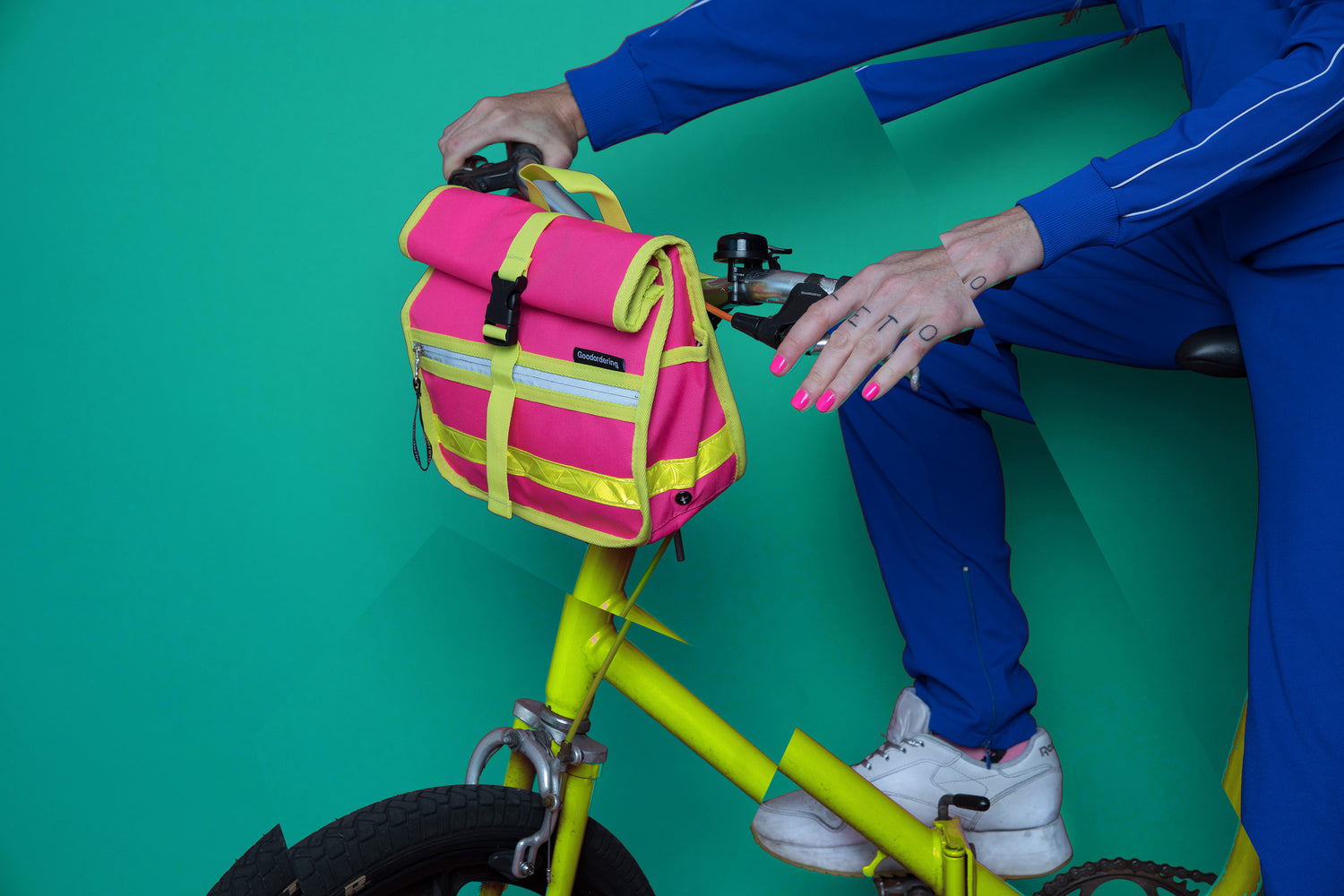
At Goodordering, we believe sustainability can be colourful, creative and fun. We are an independent London cycling bag brand founded in 2012, with a particular interest in making cycling accessories that combine practicality, personality and thoughtful design.
One of the ways we approach sustainability is through upcycling. We love finding new uses for materials that might otherwise be thrown away, transforming them into useful and interesting everyday products.
Upcycled pannier bags
Our upcycled pannier bags give discarded materials a second life. Each bag is made using reclaimed or unwanted materials, meaning that every piece has its own history and character.
Rather than producing large quantities of identical products, we embrace small runs and one-off designs. This makes the most of the materials available and allows us to create something a little different from conventional mass-produced cycling bags.
We think there is something particularly satisfying about carrying a bag that has been given a second life, especially when it has been transformed into something practical for everyday cycling.
Make your own pannier bag
We also sell DIY pannier hardware for anyone who fancies making their own bicycle bag.
Why buy a completely new bag when you might already have something at home that could be converted into one?
With the right fittings, you can transform an existing bag, backpack or other suitable container into a functional bicycle pannier. It's a great way to reuse something you already own, create a bag that reflects your personal style and experiment with your own designs.
Our pannier hardware makes this process easier, providing the essential components needed to attach your chosen bag to a bicycle rack.
We love the idea of encouraging people to get creative rather than automatically buying something new. Whether you're converting an old rucksack, adapting a vintage bag or experimenting with an unusual material, making your own pannier is a fun way to give something a new purpose.
Explore our upcycled pannier bags and DIY pannier hardware.
Small changes, bigger impact
Sustainability in cycling isn't just about finding the perfect recycled fabric or buying a bicycle made from locally sourced materials. It's about looking at the bigger picture: how products are designed, where they are made, how long they last and what happens to them when we no longer need them.
From Schwalbe's inner tube recycling scheme to Pashley's British manufacturing and Goodordering's upcycled bags, these brands demonstrate that there are lots of different ways to make the cycling industry more responsible.
And perhaps the simplest place to start is by looking at what we already own. Repairing an old bag, reusing a discarded material or converting something you no longer use into a bicycle pannier might seem like a small thing, but it's all part of a more creative and less wasteful approach to cycling.
Happy cycling!