How colour, fashion, shopping and everyday objects influence our brains, emotions and wellbeing.
Have you ever walked into a shop and immediately felt relaxed? Or put on a brightly coloured jacket and suddenly felt a little more cheerful? Maybe you’ve picked up a beautifully designed object and experienced that strange little moment of joy, even though you didn’t actually need it.
There’s a fascinating area of science that helps explain why this happens. It’s called neuroaesthetics, and it’s all about understanding how our brains respond to beauty, design, colour, art and the environments around us.
And while it sounds rather academic, neuroaesthetics is actually something we experience every single day, from the clothes we wear to the shops we visit and even the bags we carry.
What is neuroaesthetics?
Neuroaesthetics is the scientific study of how our brains respond to aesthetic experiences. In other words, it explores what happens in our minds when we see, hear, touch or experience something we find beautiful, interesting or emotionally engaging.
It combines neuroscience, psychology, art and design to investigate questions such as:
- Why do certain colours make us feel calm or energised?
- Why are we drawn to particular shapes, patterns and textures?
- Can beautiful surroundings help reduce stress?
- Why does wearing something we love change how we feel?
- Can art and design actually improve our health?
The field is closely associated with neuroscientist Semir Zeki, whose research helped establish the scientific study of how the brain processes visual beauty and art.
 Researchers have found that aesthetic experiences involve brain systems associated with perception, emotion, memory and reward. But what’s particularly interesting is that beauty isn’t simply something we look at. It’s something we experience.
And our experiences are shaped by personal memories, culture, associations and individual preferences.
That means the perfect colour, pattern or object for one person might do absolutely nothing for someone else.
Neuroaesthetics in fashion: Dressing for your brain
Fashion has always been about much more than keeping warm or covering our bodies. Clothes can express identity, create confidence, trigger memories and influence how we interact with the world.
Neuroaesthetics offers another way of thinking about fashion: not just how clothes look, but how they make us feel.
1. Colour and mood
Colour is one of the most immediate ways fashion can influence our emotional experience.
Bright colours can feel playful and energetic, while muted tones may create a sense of calm or sophistication. However, there’s no universal rule that yellow makes everyone happy or blue makes everyone relaxed. Context and personal associations matter enormously.
Think about the difference between putting on an oversized grey sweatshirt and a bright orange raincoat. Neither is inherently better, but they might create completely different emotional experiences.
At Goodordering, we’ve always loved bold colours, playful combinations and designs that don’t take themselves too seriously.
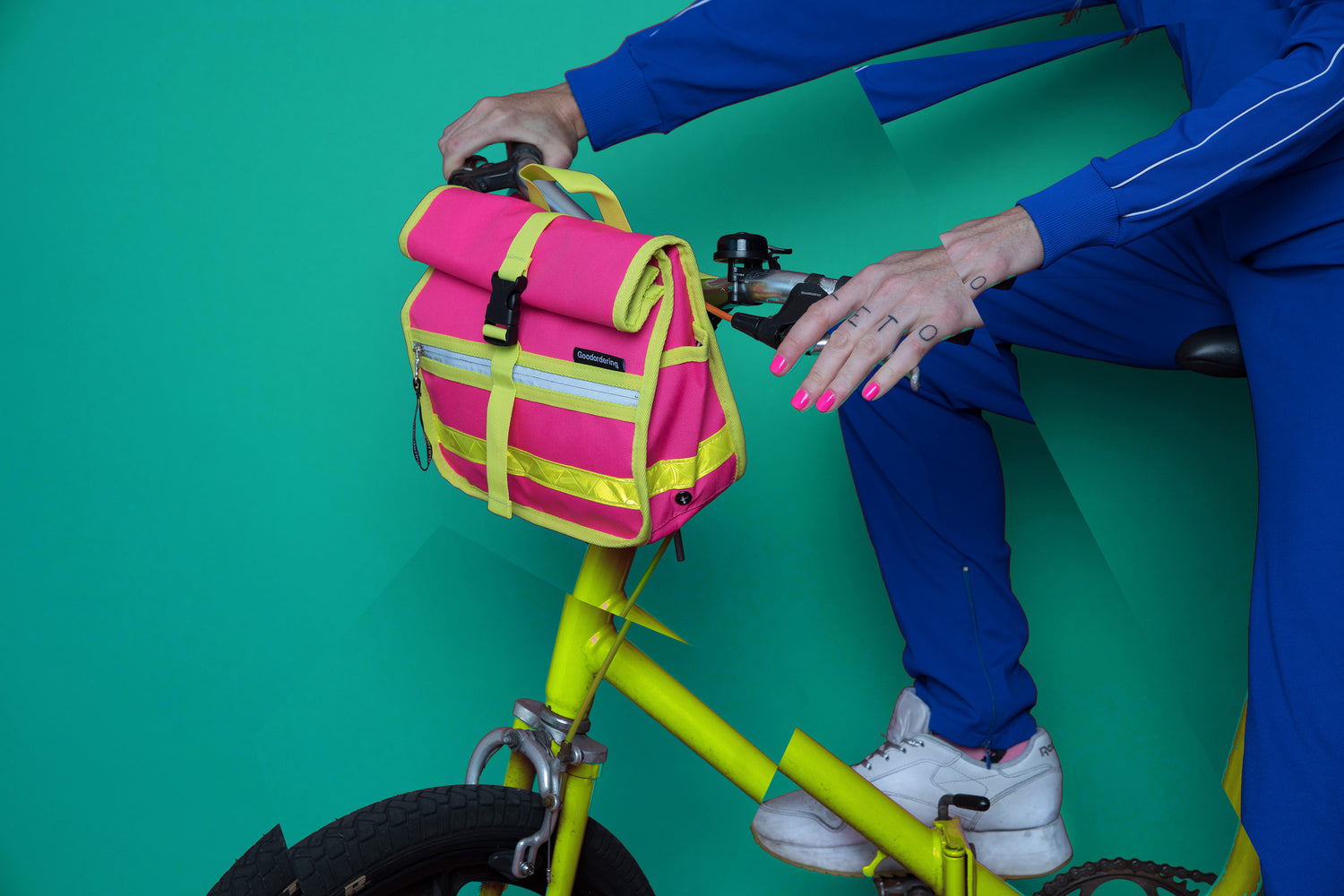
A brightly coloured cycling bag isn’t just about being visible on the road. It can also become a little expression of personality on an otherwise ordinary commute, especially in london where the drab weather of autumn and winter can get a girl down.
2. Enclothed cognition: Can clothes change how we think?
There’s a related psychological concept called enclothed cognition, which explores how the clothes we wear can influence our attention, behaviour and self-perception.
One well-known experiment investigated whether wearing a white coat could affect performance on attention tasks, depending on what participants believed the coat represented.
The research suggests that clothing can carry symbolic meaning that influences how we behave, although the strength and reliability of these effects are still being studied.
Think about putting on your favourite trainers, a smart jacket or a beautifully made dress. Sometimes the clothing itself becomes part of the mindset.

It’s not magic. It’s the relationship between what we wear, what it means to us and how we feel about ourselves.
3. Texture, touch and comfort
Neuroaesthetics isn’t only about what we see.
The feel of materials matters too.
Soft cotton, smooth nylon, chunky knitted wool, polished metal and textured canvas all create different sensory experiences.
A bag with a satisfying zip, comfortable straps and a lovely tactile finish can make everyday use more enjoyable.
This is where fashion design meets sensory design. A product should ideally feel as good to use as it looks.
Neuroaesthetics in retail: Why some shops just feel better
Retailers have understood the emotional power of design for decades, even if they weren’t calling it neuroaesthetics.

Lighting, colour, music, scent, layout and materials all influence how we experience a shop.
But neuroaesthetics offers a more scientific framework for understanding why these elements matter.
1. The power of store design
Walk into an Apple Store and you’ll notice the open spaces, simple displays, natural materials and relatively restrained colour palette.

Above: Apple Store Kyoto
Walk into a colourful independent gift shop and you might experience something completely different: visual excitement, curiosity and a desire to explore.
Both approaches can be effective, but they create different emotional environments, so the challenge is to work out which one will attract the customers that you want.
A minimalist space might help some customers focus, while a colourful, densely stocked shop might encourage discovery and surprise.
The important thing is understanding the experience you want people to have.
2. The joy of discovery
Have you noticed how satisfying it can be to discover a tiny independent shop filled with unusual objects?
Part of the pleasure comes from novelty and surprise.
Our brains respond to new and interesting experiences, especially when they connect with things we already enjoy.
This is particularly relevant to museum shops, independent design stores and lifestyle retailers.
Products aren’t always purchased purely because they’re practical. Sometimes we’re buying a story, a memory, a feeling or a little moment of happiness.
At Goodordering, we love the idea of products that make people smile before they’ve even used them.
A colourful bag, a funny patch or a playful accessory can create an emotional connection that goes beyond its basic function.
3. Online shopping and visual pleasure
Neuroaesthetics also has interesting implications for online retail.
Customers can’t physically touch products on a website, so photography, colour, composition and visual storytelling become especially important.
For example, showing a cycling bag against a plain background helps customers understand the product.

But showing that same bag on a bicycle outside a colourful London café tells a different story.
It helps someone imagine the bag becoming part of their own life.
For a brand like Goodordering, this is why lifestyle photography, playful styling and colourful imagery are such important parts of communicating what our products are about.
Of course, beautiful design still needs to be backed up by clear information, easy navigation and products that actually work.
Neuroaesthetics in healthcare: Can beauty help us heal?
Perhaps one of the most interesting applications of neuroaesthetics is in healthcare.
Hospitals and medical environments have traditionally prioritised hygiene, efficiency and clinical functionality.
All essential, of course.
But researchers and designers are increasingly interested in how the physical environment affects patients, visitors and healthcare workers.
1. Art in hospitals
Imagine lying in a hospital bed looking at a blank wall under fluorescent lighting.
Now imagine the same room with natural light, a view of trees and a beautiful piece of artwork.
The medical treatment might be identical, but the experience of being in that room could feel very different.
A landmark 1984 study by environmental psychologist Roger Ulrich found that surgical patients with a view of trees had better outcomes on certain recovery measures than patients looking at a brick wall.
It was a relatively small observational study, so it doesn’t prove that every natural view improves recovery. Nevertheless, it helped inspire decades of research into healthcare environments.
Today, hospitals increasingly consider artwork, access to nature, daylight and calming interiors as part of patient-centred design.
2. Colour and healthcare spaces
The familiar image of a hospital is often a sea of white walls, clinical blue curtains and harsh lighting.
But healthcare environments don’t necessarily have to feel cold or institutional.
Thoughtful use of colour can help spaces feel more welcoming, support wayfinding and create different atmospheres for different activities.
Children’s hospitals, for example, often use playful graphics, murals and colour to make unfamiliar spaces feel less intimidating.
However, colour alone isn’t a medical treatment, and responses vary between individuals.

Parkview Cancer Institute
The goal is to create surroundings that support comfort, dignity and a better experience of care.
3. Art, creativity and wellbeing
There’s also growing interest in the relationship between creative activities and wellbeing.
Drawing, painting, making things, listening to music and engaging with art can provide opportunities for relaxation, expression and social connection.
A major World Health Organization review examined thousands of studies exploring the role of the arts in health and wellbeing.
The findings suggest that arts engagement can contribute to health promotion and support aspects of care, although the evidence varies considerably between activities and medical conditions.
It’s important not to confuse this with claims that looking at beautiful things can cure illness.
But helping people feel calmer, more connected or more comfortable is valuable in its own right.
Everyday neuroaesthetics: Small things that make life better
One of the loveliest things about neuroaesthetics is that you don’t need an art gallery, luxury hotel or expensive designer wardrobe to experience it.
It’s often the ordinary things that matter.
A favourite mug that feels perfect in your hand.

A beautifully arranged market stall.
The satisfying click of a well-made clasp.
A colourful bicycle parked against an old brick wall.
A patch sewn onto a bag that reminds you of somewhere you’ve been.
These little sensory and emotional experiences are part of our everyday relationship with design.
They might seem insignificant individually, but they help shape how we experience our surroundings.
How neuroaesthetics connects to Goodordering
At Goodordering, we’ve always believed that practical things don’t have to be boring.
A cycling bag needs to do its job. It should be comfortable, durable, easy to use and thoughtfully designed.

Goodordering pink and yellow handlebar bag
But why shouldn’t it also make you happy?
Our approach to design has always combined functionality with colour, personality and a little humour.
A bold colour combination can make a practical accessory feel more playful.
A comfortable strap or satisfying fastening can make using a bag a nicer experience.
A distinctive shape can make an everyday object feel like something worth keeping.
And a well-designed cycling bag can make the experience of travelling around a city feel just that little bit easier and more enjoyable.
This is where neuroaesthetics becomes particularly interesting to us.
It’s a reminder that good design isn’t simply about making things look attractive. It’s about understanding how people experience them.
The best everyday objects don’t just work well. They make us feel something too.
The future of neuroaesthetics in design
As research develops, neuroaesthetics could influence how we design everything from fashion collections and retail spaces to hospitals, workplaces and public transport.
We may see more attention paid to sensory comfort, personalised environments, emotionally engaging products and the relationship between aesthetics and wellbeing.
But there’s also a danger of turning neuroaesthetics into another marketing buzzword.
Not every colourful product boosts dopamine. Not every curved sofa reduces stress. And there’s certainly no single design formula that makes everyone happy.
The science is much more nuanced than that.
What neuroaesthetics does offer is a fascinating way to ask better questions about design.
How does this object make someone feel?
Does this space encourage curiosity or create stress?
Can something be practical, beautiful and emotionally meaningful at the same time?
And perhaps most importantly, can we make everyday life a little more enjoyable through the things we design?
At Goodordering, we certainly think that’s an idea worth exploring.
Because sometimes a bag is just a bag.
And sometimes it’s the little splash of colour that makes your journey to work feel a whole lot better.
Read more about colour on my other article called Primary Colours in Art and Design.